During an air raid on the city of Meiktila, Burma (today’s Myanmar), on Aug. 3, 1943, a B-25 bomber fell out of the sky and crashed. Only two members of the six-man crew managed to bail out, but they were captured by Japanese soldiers. The rest of the crew, including Lt. Henry “Harry” J. Carlin, the bomber’s 27-year-old navigator from Philadelphia, Pennsylvania, went down with the aircraft. Local villagers discovered the crew’s remains and buried them in a common grave, all unidentified.
The raid, conducted by the U.S. Army Air Forces’ Tenth Air Force, was part of an Allied effort to push back a Japanese offensive through Burma, strategically located between China and India. The China-Burma-India Theater has often been called “The Forgotten Theater” of World War II because the European and Pacific theaters held priority for both men and weapons. The Tenth Air Forces’ efforts included bombing raids to strike bridges and installations behind Japanese lines.
Carlin and his fellow airmen may have remained unidentified, but they were not forgotten. In 1947, the members of the American Graves Registration Service recovered the remains and attempted to identify them, unsuccessfully. They were then buried as unknowns in the Manila American Cemetery and Memorial in the Philippines, where the crewmen’s names were listed on the cemetery’s Wall of the Missing.
In 2022, the Defense POW/MIA Accounting Agency (DPAA) exhumed the unknowns in a second effort to identify them. Historical research connected one set of remains to Carlin. By the time the connection was made, however, Carlin’s closest living relatives were his nieces and nephews, who knew very little about him.
Thus, Carlin’s oldest niece, Nancy Figel, was surprised when DPAA reached out to her for a DNA sample. “I lived with him being missing in action for so long that I didn't think his remains could be found,” she said. With DNA from Figel and her brother Henry, DPAA positively identified Carlin in 2025, more than 81 years after his bomber crashed.
Carlin’s extended family chose Arlington National Cemetery for their uncle’s final resting place since it was closer to his childhood home than his niece’s home in Chicago. “He was an east coast boy,” Figel said. “It just seemed fitting to have him buried in the part of the country where he was comfortable.”
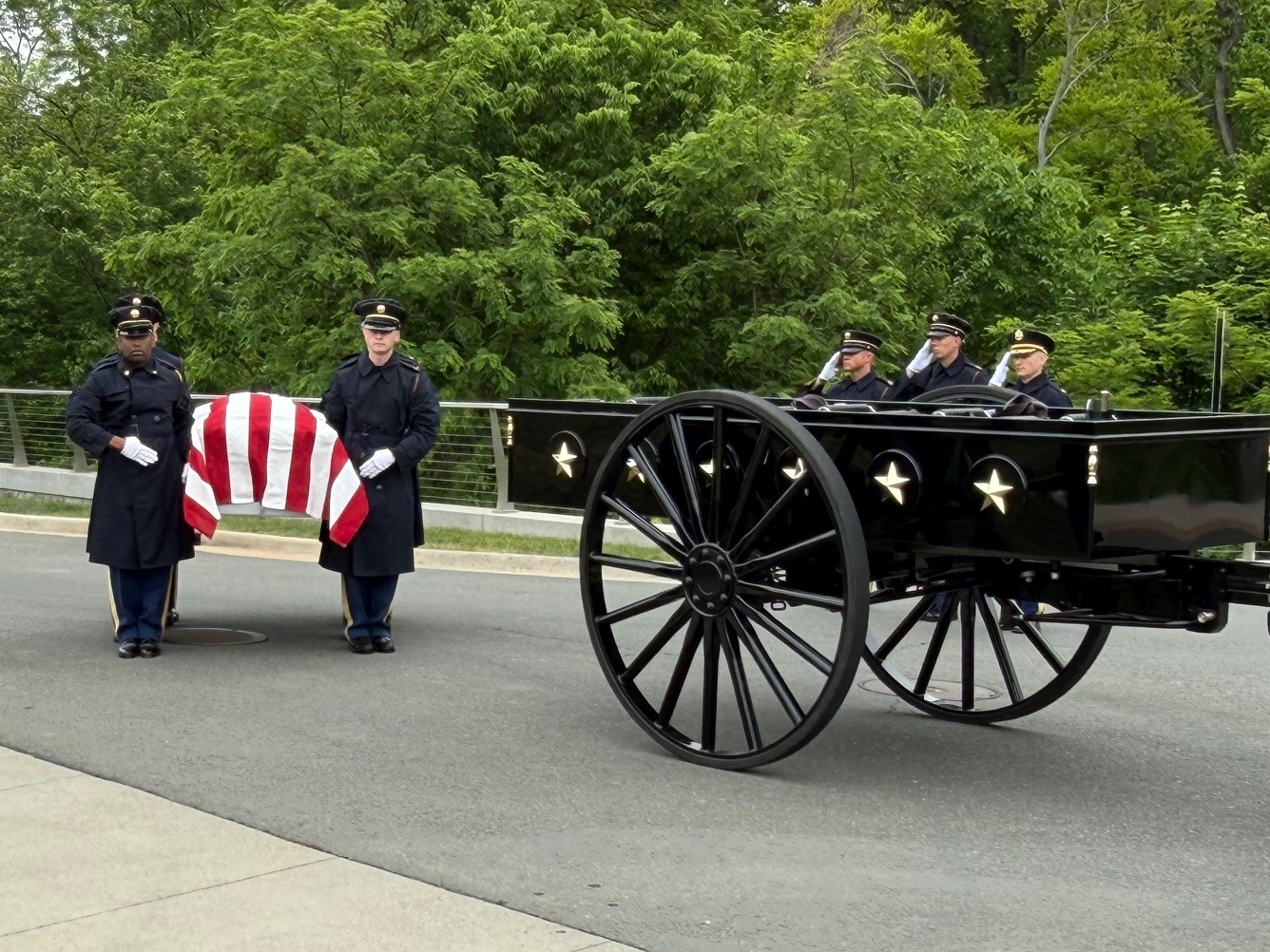
At Carlin’s funeral service in Section 81, on April 29, 2026, U.S. Army Chaplain (Capt.) Matthew Faucett spoke about Carlin’s military combat medals, which included the Distinguished Flying Cross, the Air Medal and the Purple Heart. After an Army firing party fired three volleys and a bugler sounded Taps, Figel held back tears as Capt. Noah Van Blarcom presented her with the flag that had been draped over her uncle’s casket. “That was such a profound feeling,” she said. “There was so much solemnity in the occasion.”
After the service, Figel’s cousin, Patti Carlin, praised DPAA’s efforts to identify her uncle. “They found him and cared for him,” she said. “This funeral service is also a big tribute to them. It’s come full circle.”
Figel added that she was in awe of her uncle’s sacrifice. “The fact that he gave his life like that and the list of the medals he earned for the risks he took to help other soldiers and the war effort,” she said, “that means a lot.”
Carlin may have fought in the “forgotten theater” of World War II, but his nation continued to remember his service and sacrifice. He was finally returned home to rest in peace at Arlington National Cemetery.