Charles R. “Rich” Smith served in the U.S. Army during the Vietnam War, but spent most of his professional career as a civilian historian for the U.S. Marine Corps. Working for the U.S. Marine Corps History and Museums Division, he wrote numerous books and articles, including “Marines in the Revolution: A History of the Continental Marines in the American Revolution 1775-1783.”
Smith had already earned his master’s degree in history from San Diego State University when the U.S. Army drafted him during the Vietnam War. He served with the 101st Airborne Division in Vietnam from 1968 to 1969, first as an artilleryman and later as a unit historian. His exceptional performance led an officer to recommended him for a civilian historian position with the Marine Corps.
After being honorably discharged from the Army, Smith moved to Washington, D.C., where he spent the next 40 years working as a Marine Corps historian. Following the 1975 publication of “Marines in the Revolution,” he wrote “U.S. Marines in Vietnam: High Mobility and Standdown 1969,” published in 1988. Over the course of his career, he earned numerous awards and promotions and mentored younger historians.
In June 1973, Smith met Barbara Rhenish and the two married five months later. After 10 years of marriage, they ultimately discovered, according to Rhenish, that they were better friends than partners. Although they divorced and Rhenish remarried, they remained close. Smith even mentored Rhenish’s son, Alexander Hinman, through graduate school and into his internship with the Marine Corps History and Museums Division. “My son’s an excellent writer and part of it is because of Rich,” she said. “He was one of Rich’s proudest achievements.”
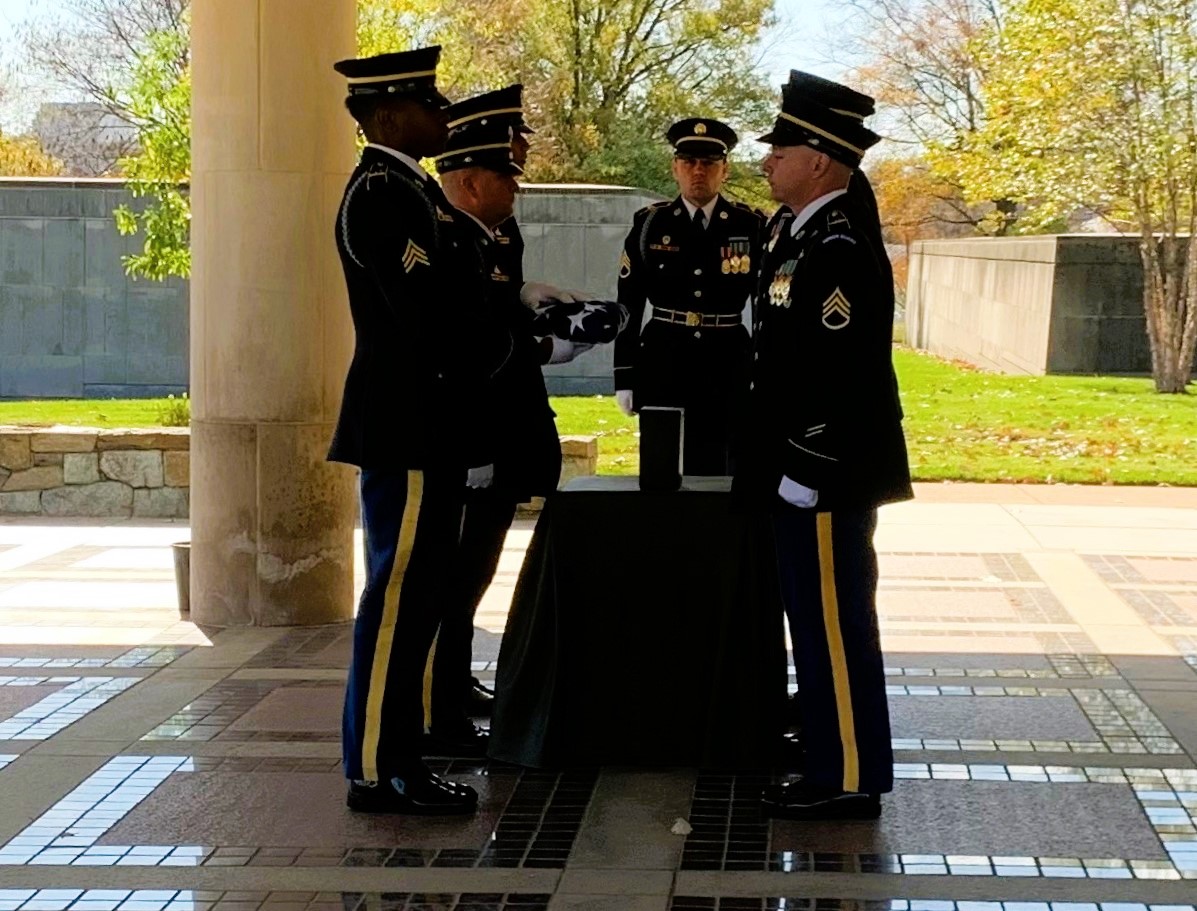
Smith passed away at the age of 81. On Nov. 13, 2025, his family, friends and colleagues came to Arlington National Cemetery to bid him a final farewell.
U.S. Army Chaplain (Capt.) Shannon Demoret told the mourners that Smith had received awards and decorations for his honorable service in Vietnam, including the Bronze Star. Smith’s brother, Russell, accepted the trifold flag and carried his brother’s urn to the niche wall.
After the service, Smith’s colleague Nicholas Schlosser reflected on his legacy, saying Smith set the standard for Marine Corps history. “If I ever had a question, it was always, ‘Well, check with Rich,’” he recalled, adding, “He was just one of the kindest, gentlest people I've ever met.”
Hinman called Smith his “bonus dad,” explaining that Smith often babysat for him and picked him up from school, in addition to teaching him history. “He was a mentor and an inspiration,” Himan said. “I really enjoyed him, and I really miss him.”