For most of her childhood, Robin Harris knew her father was serving his country far from home, but she did not know why. That changed in the seventh grade, when a fellow student told her, “I heard your dad is in the Hanoi Hilton.” Not knowing what he meant, she asked her mother, Louise Harris, who explained that her father could not come home. He was a prisoner of war.
On April 4, 1965, Robin’s father, U.S. Air Force Capt. Carlyle “Smitty” Harris, was shot down over North Vietnam, becoming one of the first American pilots held in the infamous Hỏa Lò prison system, which prisoners of war dubbed the “Hanoi Hilton.” He spent 2,871 days — nearly eight years — as a POW.
Harris soon taught his fellow prisoners, and all the prisoners who followed, how to communicate through a tap code, which he had learned in survival training. Now, whenever prisoners were separated, put into solitary confinement or recovering from torture, they could stay in touch and keep up each other’s morale.
Three months after Capt. Harris’s capture, he and 51 other American prisoners were paraded through downtown Hanoi, where civilians hit and hurled objects at them. Back at home in Okinawa, Japan, Louise watched an edited version of the parade on television and saw her husband alive and walking, which she described as “a blessing.”
During their four years of marriage, the couple had developed nicknames for each other. On one of their first dates, Harris accidentally called Louise “Jane,” and she responded by telling him, “Well, Tarzan, get my name right.” After Capt. Harris’s capture, Louise had to raise their two daughters—four-year-old Robin and three-year-old Carolyn—on her own while pregnant with their son, Lyle. For eight years, she did her best to shield her children from the daily news and made sure that they prayed every night for their father’s safe return.
Finally, in 1973, as the Vietnam War wound down, the North Vietnamese began releasing prisoners in groups. Harris, who had been one of the first pilots captured, was among the first group released. Louise brought their children and extended family to Maxwell Air Force for an early morning reunion on Feb. 16, 1973. She waited in a car while Harris stepped off an aircraft and addressed the press. When he finally got in the car and, they embraced as he asked, “How are you doing, Jane?”
Harris brought gifts for everyone, and some had gifts for him. Louise’s sister, Janice, presented him with a large box. According to Louise, when he opened it and found it filled with rice, the staple of his diet in Vietnam, he burst out laughing.
After the children adapted to having their father around, life eventually returned to normal. “Smitty went back to being normal Smitty,” Louise said. “He always had a good sense of humor, and it remained intact.” Harris resumed his Air Force career until retiring in 1979 to pursue successful careers in law and banking. When Harris passed away on July 6, 2025, Louise chose to have him laid to rest at Arlington National Cemetery. “He grew up on Maryland’s Eastern Shore,” she said, “and as a young, single Air Force officer, he always wanted to be buried at Arlington.”
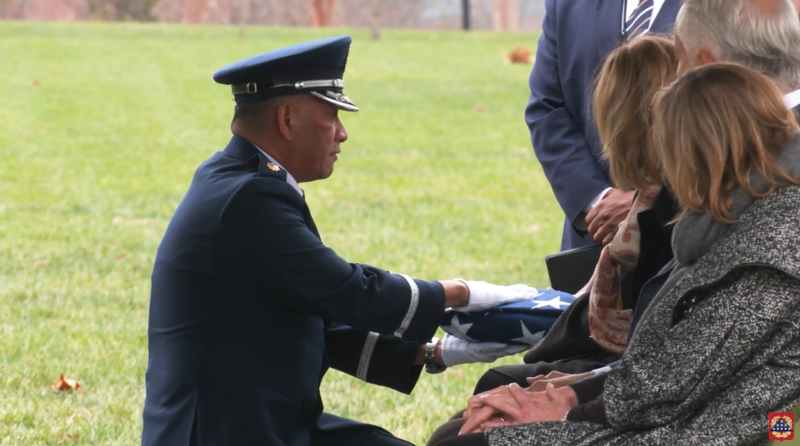
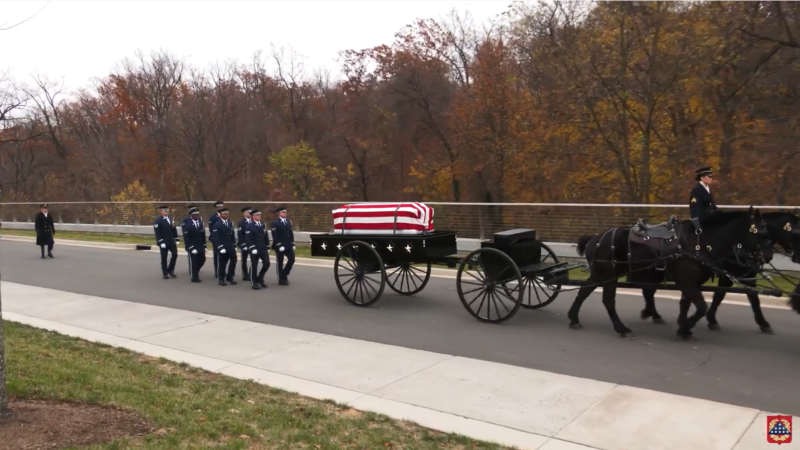
On Nov. 20, 2025, Harris’s family and friends gathered in Arlington National Cemetery’s Section 81. Once the service ended, Louise’s grandson pushed her wheelchair to Harris’s casket. She placed a hand on it, as if to say a final goodbye to her Tarzan.