U.S. Air Force Maj. John Casteel saved six U.S. Navy aircraft and their crews over Vietnam’s Gulf of Tonkin on May 31, 1967—and made history in the process. The Navy planes were running so dangerously low on fuel that they could not reach their aircraft carrier without an emergency refueling from Casteel’s KC-135 Stratotanker. In response, Casteel performed the first-ever tri-level fueling, in which one aircraft refueled a second aircraft, and the second aircraft refueled a third.
On that day, Casteel had just finished refueling two Air Force jets over the Gulf when he received an emergency request from two Navy KA-3 Skywarrior refueling aircraft that desperately needed gas. They were too low on fuel to reach Casteel, so he left his assigned station and flew to their location, where one of the KA-3s connected to his trailing tail boom and started refueling. Before they could finish, four “thirsty” Navy F-8 Crusader jets flew in, also needing refueling. One of the F-8s flew behind the KA-3—still linked to Casteel’s aircraft—and refueled from its tail boom, creating the first tri-level refueling. Fortunately, the KA-3 took on fuel faster than it dispensed. One by one, the other three F-8s refueled. When the five aircraft finished, the second KA-3 refueled from Casteel’s KC-135. Once the refueling was completed, the Navy pilots thanked Casteel and his crew and headed to their carrier.
The Air Force presented the Distinguished Flying Cross to Casteel and his crew. The Air Force also awarded them the 1967 MacKay Trophy, given for the most meritorious flight of the year. Today, his KC-135 is on permanent display at the National Museum of the United States Air Force at Wright-Patterson Air Force Base in Dayton, Ohio. Clck here for more information about the aircraft and its history.
“What my dad did was so heroic,” Casteel’s oldest daughter, Holly Wiley, said. Wiley, who was eight years old when her father earned the MacKay Trophy, was one of three children that Casteel had with his wife, Colleen. Wiley had an older brother, Scott (who died in 2023), and a younger sister, Diane.
Casteel met Colleen Jones at Elliot High School in Akron, Ohio. He took her to a house party, where he put their coats together on a bed and wrapped his coat sleeve around her coat, playfully displaying his interest in her. They married in 1956, two years after Casteel enlisted in the Air Force. Wiley described her mother as the disciplinarian and her father as the fun one. “Whenever he came home, everything he did was lightness,” she recalled. The family celebrated his career by naming their dog Casey, in honor of the KC-135 their father flew.
Wiley loved growing up in an Air Force family, finding it a “great adventure” to live in numerous places, including Oklahoma, California and Washington, D.C. She fondly recalled playing in the park with the children of her father’s flight crew at the Clinton-Sherman Air Force Base in Oklahoma, eating peanut butter and jelly sandwiches on white bread from her father’s flight lunches and catching the smell of his flight uniform. “My mother only bought wheat bread,” she explained, “and my dad was bringing these flight lunches home and letting us eat them. They were the best thing I've ever eaten in my life.” As for the smell of her father’s uniform, she assumed it came from jet fuel, and today she continues to notice that other airmen “smell like my dad.”
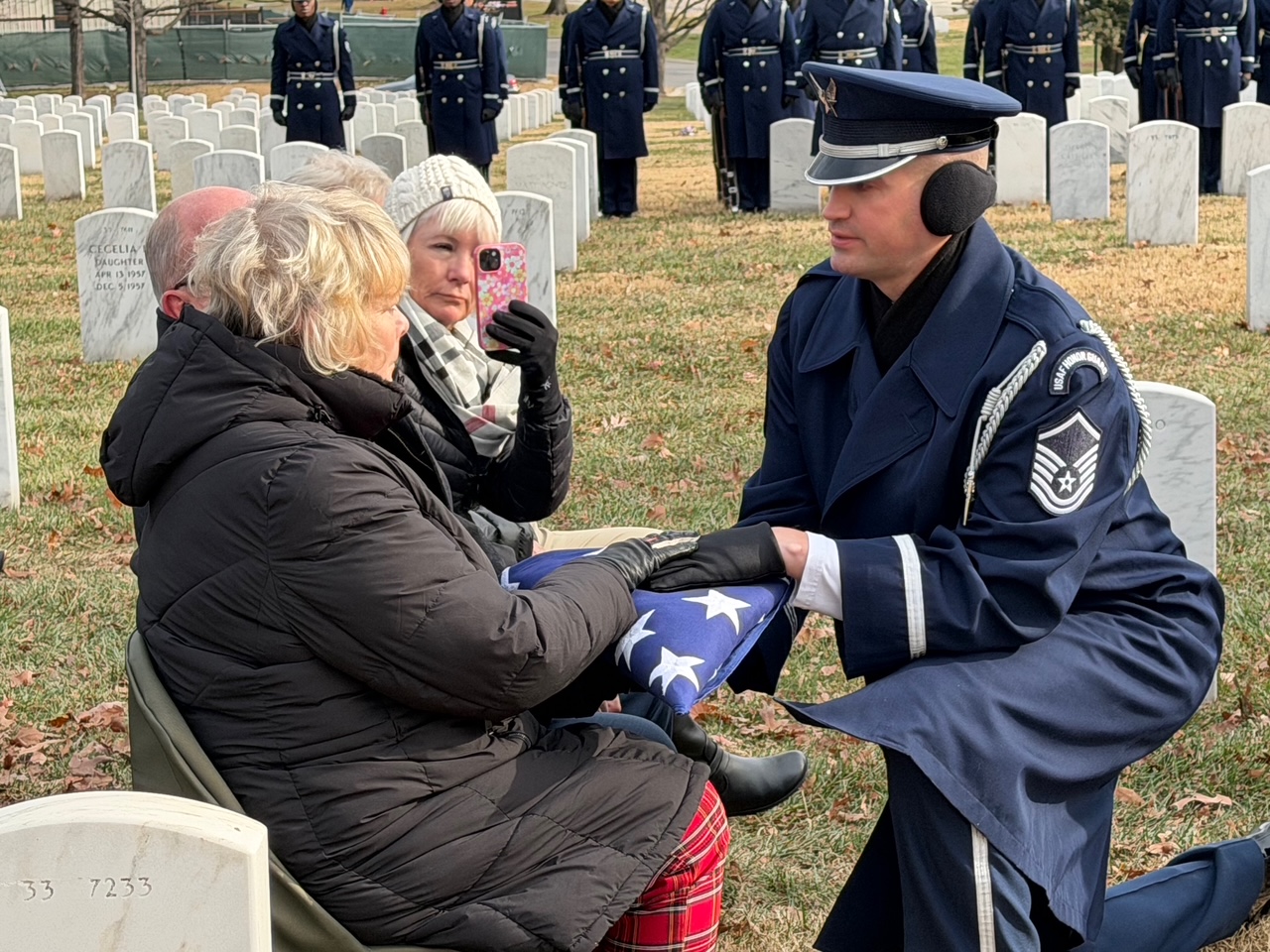
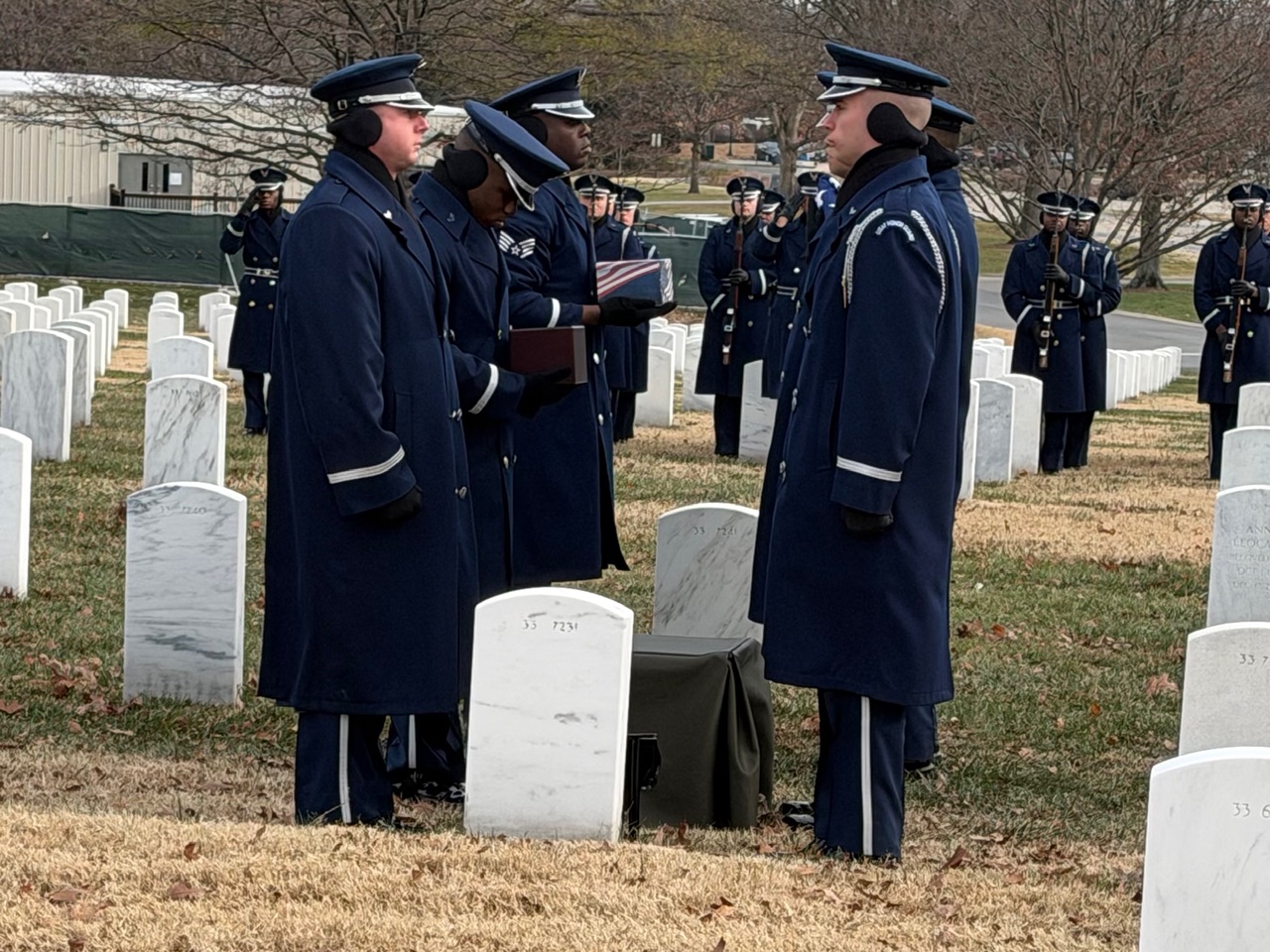
Colleen passed away on April 30, 2023, and Casteel followed her almost exactly a year later on April 11, 2024. They were buried together in Arlington National Cemetery’s Section 33 on Dec. 12, 2025. Wiley had decided that her sister, Diane Burbridge, should accept the tri-folded flag at the service. “My husband and I already have my father-in-law's flag,” she said, “so when Diane asked who would accept the flag, I told her, ‘You are, because you cared enough to ask.’”
At the service, tears fell from Burbridge’s eyes as Air Force Master Sgt. Kenneth Barrows presented her with the flag. “It was just the most beautiful emotional thing I’ve ever seen,” Wiley said, “and I’m sure she’s going to relish it for the rest of her life.”
Wiley remembered seeing, when she was a teenager, veterans sob when military bands played their branch songs on Washington, D.C.’s National Mall. Inspired by this, she decided to have her parents buried at the cemetery. “My dad was a hero,” she said, “and we wanted to give him everything.”