U.S. Navy Lt. Junior Grade Harlan Foote worried that the wings of his torpedo bomber might rip off as he dove at a steeper-than-usual angle toward a Japanese heavy cruiser in Japan’s Kure Harbor. But the aircraft held together as he braved anti-aircraft fire and released his bombs, hitting the cruiser several times. As he returned to his aircraft carrier, he continued to dodge heavy enemy anti-aircraft fire for what seemed like hours, even though it was only a few minutes.
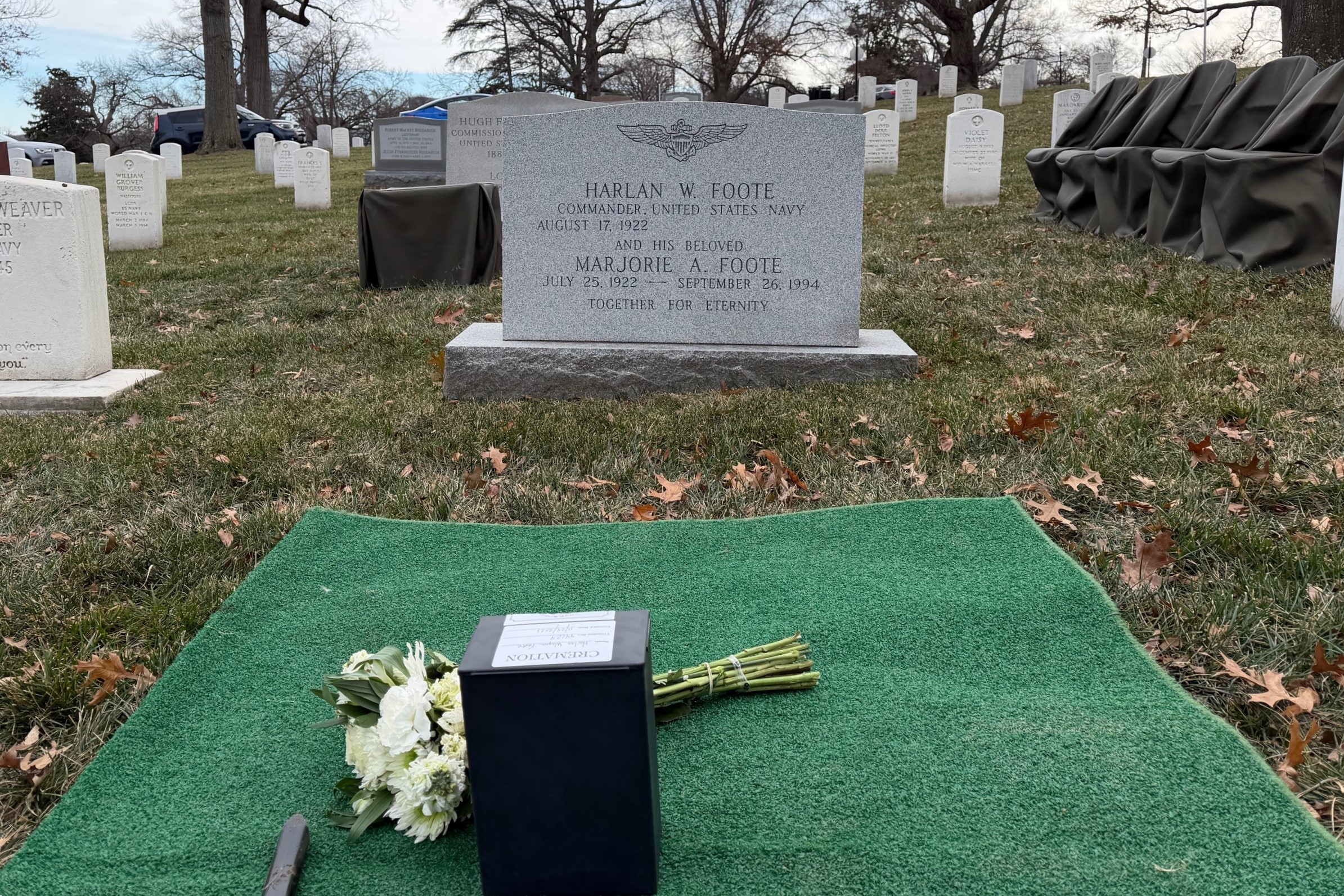
Foote had been part of a March 19, 1945, raid to sink what was left of the Imperial Japanese Navy, and his performance earned him the Navy Cross—the Navy’s second-highest military decoration. Writing about his military service in 2002, he described the attack as his “most significant bombing mission.” Foote subsequently earned medals for his service in the Korean War, as well as a 1965 commendation for advising NASA on how to recover space capsules. After a career of service to his country, Foote lived to 101. On Jan. 16, 2026, he joined his first wife, Marjorie, in Section 37 of Arlington National Cemetery.
Growing up on farms in Depression-era Iowa, Foote developed a passion for flying after seeing an aircraft land in a field. “After that, he always wanted to learn to fly,” his niece, Shelly Foote, said. He was taking flight lessons in college when Japan attacked Pearl Harbor, so he joined the Navy and attended flight school. During World War II, he flew dangerous bombing and staffing missions over the Gilbert and Marshall Island chains, as well as over the Japanese mainland (including the raid on Kure Harbor).
Foote knew the harbor raid would be difficult when he received a change-of-target message over the radio while in flight. “In the background, you could hear the fighter pilots’ frantic call for help,” he later wrote. As he and the other pilots reached the harbor, the anti-aircraft fire was so intense that one pilot said they could almost walk on it. When a round ricocheted off the flight leader’s windshield and into his wing prior to exploding, the formation broke up, and Foote dove on the heavy cruiser. Later aerial photographs confirmed his hits, earning him the Navy Cross.
After the raid, during the last five months of the war, Foote survived both a typhoon and a Kamikaze attack. He was preparing to launch his aircraft when the Kamikaze plane struck nearby. “It crashed in flames so close to the starboard quarter that I could feel the heat while in the cockpit,” he later wrote.
 Foote left the Navy after the war, but he missed the service and soon rejoined, serving until his retirement as a commander. During the Korean War, he flew night missions off the coast of South Korea and was aboard the USS Bennington when, on May 26, 1954, a catapult malfunction caused an explosion that rocked the carrier and killed more than 100 sailors. “He said that seeing all the body bags on the flight deck was more upsetting than when he was in actual combat,” Shelly recalled.
In his eulogy, U.S. Navy Chaplain (Lt.) Everett Fraley called Foote a great American and a true hero. After listing Foote’s accomplishments, Fraley described the fear he must have felt while diving on that Japanese cruiser. “But he set his fear aside to do the task and to complete the mission, and that is why we are honoring him today,” he said. “It was men like Harlan who won World War II.”
Shelly held back tears as she accepted her uncle’s tri-folded flag. Seeing Foote’s urn and a bouquet of flowers in front of Marjorie’s headstone, she concluded by saying, simply, “This is where he wanted to be.”