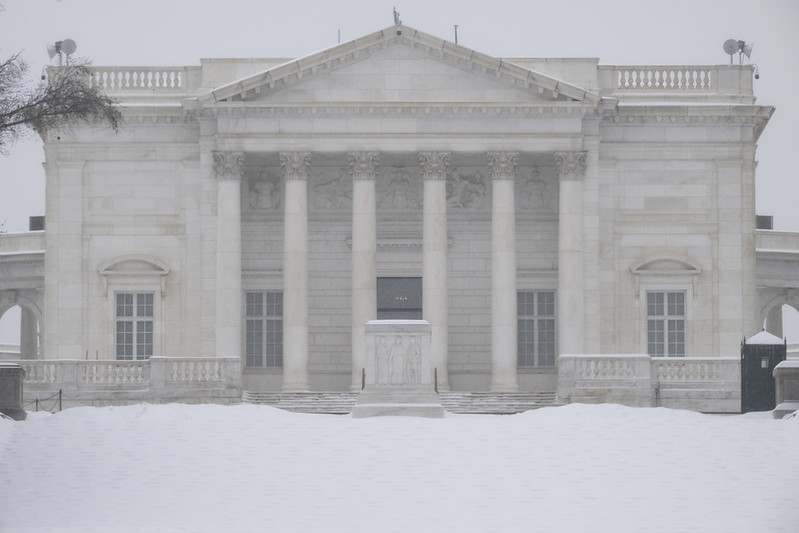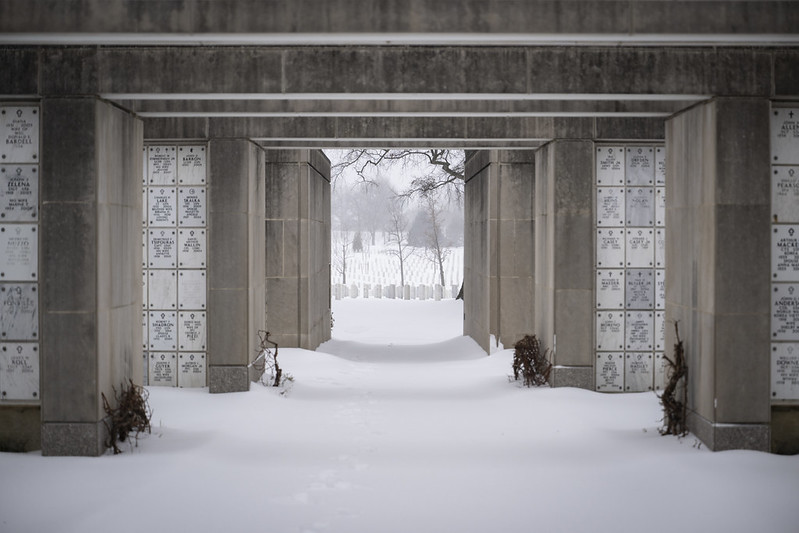
In the wake of a major snow and ice storm that blasted the Washington, D.C., area on Sunday, Jan. 25, 2026, multiple Army National Military Cemetery (ANMC) teams worked around the clock to ensure they completed their mission of laying service members to rest with dignity and honor at Arlington National Cemetery (ANC). The storm blanketed the area with seven inches of snow, topped by a four-inch layer of ice—and, for safety reasons, necessitated the cemetery’s closure to visitors and family pass holders for more than two weeks.
Fleet Maintenance Supervisor Daniel Coppage described ANMC’s efforts as “all hands on deck.” Maintenance Facility crews plowed the streets; Fleet Maintenance teams repaired vehicles and equipment; Interment Operations employees dug graves and cleared paths to funeral service sites; and Interment Services specialists escorted funeral attendees to their loved ones’ final resting places. The Fleet Maintenance and Interment Operations teams also helped plow the snow and ice that covered ANC’s 639 acres.
ANMC’s robust response to the storm resulted from the team’s advance planning. With frigid temperatures predicted for the following week, Interment Services leaders had already decided to conduct a portion of each scheduled funeral service inside the Administrative Building and hold military funeral honors under shelters near the cemetery’s columbaria. The Friday before the storm, the Interment Operations team placed orange cones at burial sites so they could find them in the snow, while Facilities Maintenance drivers salted the streets. On Saturday evening, Facilities Maintenance and Fleet Maintenance teams arrived, prepared to spend multiple nights at the cemetery; many brought three days’ worth of food.
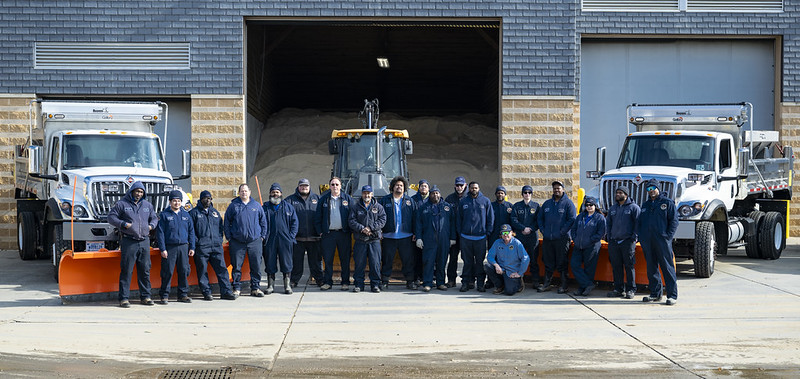
ANMC Facilities Maintenance, Fleet Maintenance and Interment Operations Teams
As the snow fell on Sunday, teams plowed the streets and parking lots—but then came the sleet. When the temperature dropped further that night, the accumulated layer of sleet turned the snow into a solid block of ice. “It just kept freezing more and more every night, to where the ice was solid from the top to the bottom,” Maintenance Mechanic Supervisor Ralph Coppage explained. When snowplows could not penetrate the ice, the team used backhoes to break it up, enabling plows to push it off the roads. “It was like trying to remove nine inches of concrete off of every street,” Coppage added.
Crews began plowing before sunrise and did not stop until 10 a.m., when they took their first break to eat. Then it was back to work. Maintenance Mechanic Work Leader Trevor Pope described the work as exhausting but appreciated that supervisors allowed the team to take breaks before pushing through. That night, crew members slept on chairs, cots and air mattresses. “We were here for the duration,” Ralph Coppage said.
By Monday morning, with streets, entrances and parking lots cleared to conduct funeral services, the Interment Operations teams went to work. They cleared paths to the columbaria shelters and gravesites, enabling funeral services to continue. Chief of Interment Operations Steven Hendley made an emergency purchase of ice cleats for his team. “Everything we did took three times the amount of time, as well as double, if not triple, the amount of people,” he said. “We wanted to make sure we were putting safety at the forefront for our folks, as well as for families here for services.” He added that ANMC leaders’ decision to close the cemetery to the public allowed his team to focus on burials.
Interment Operations used heavy machinery to break paths to nine gravesites, where teams shoveled away ice from graves and their surrounding areas. According to Engineer Equipment Operator Supervisor Ciro Salamanca, it took up to 30 minutes to break the ice before crews could clear it with shovels. Digging and filling in graves, a process that usually requires a few hours, now took up to three days. Slopes proved especially challenging, requiring specialized equipment to reach gravesites. For safety reasons, Salamanca “told everyone we were not going to rush to do anything.” But, he added, “we still got everything done on time.”
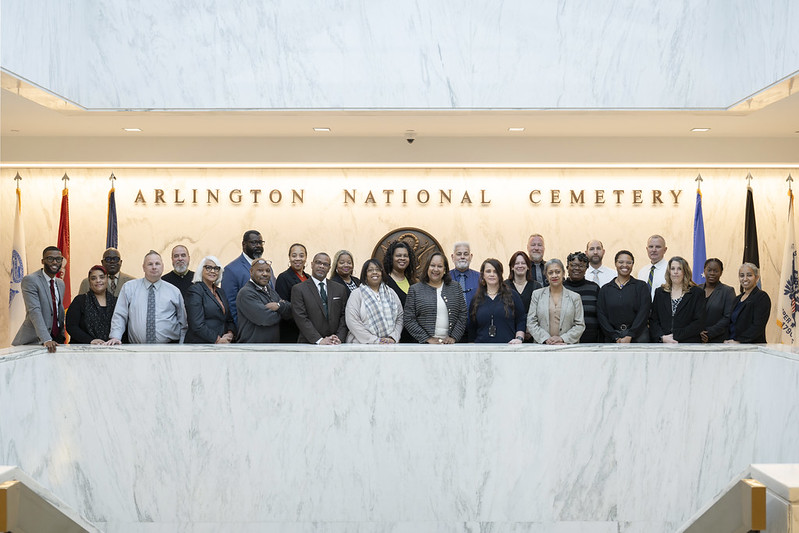
ANMC Interment Services Team
When families arrived for funeral services, instead of heading to the burial site for the committal portion of the service, a chaplain provided prayers and eulogies in the Administration Building. Then, a cemetery administration specialist led the funeral procession to one of the permanent shelters for military funeral honors. From there, the specialist led the procession to the burial site. But instead of walking the families to the burial location, they asked them to remain in their cars while the specialist walked out to the burial location and pointed it out.
In the words of Cemetery Administration Specialist Brian Hill, who coordinated at least two funerals per day during the two weeks after the storm: “If someone in my family was getting buried here, I would want somebody to take the extra precautions and see it all the way through.”
Despite the snow, ice and freezing temperatures, the cemetery did not cancel a single scheduled funeral service during those two weeks. “If the families can make it here, we are here to support them,” Cemetery Administrator Joseph Rodriguez said. “That’s our mission.” Salamanca agreed, noting the teamwork across departments and professions. “Everyone worked together to get the job done,” he said. “Everybody was out there.”
Many of the team members saw snow and ice removal, even after a storm like the one that hit that Sunday, as just part of their job. Pope took pride in his part, plowing the cemetery’s streets. “If it comes again,” he assured, “we will be back at it again.”