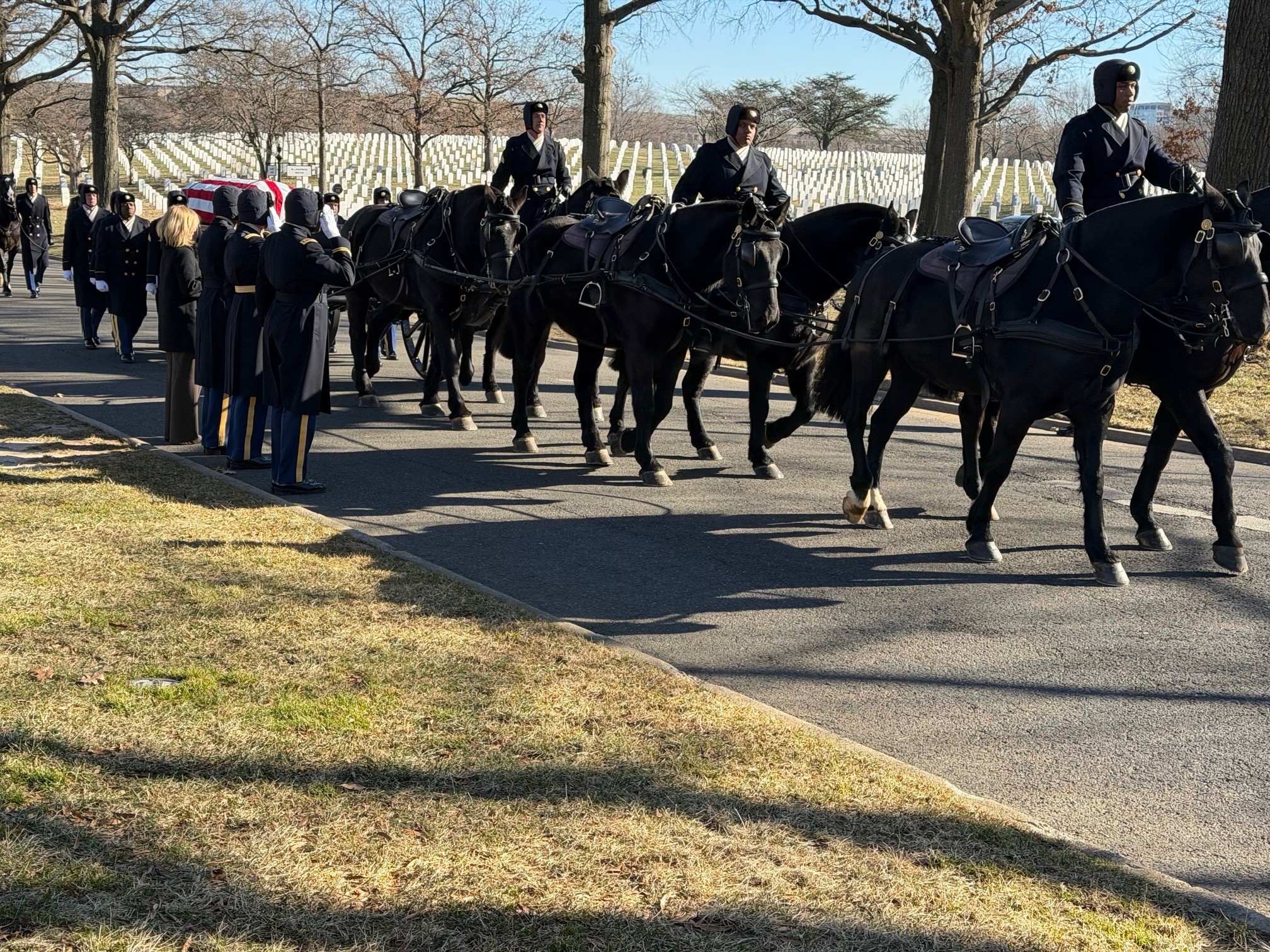
U.S. Army Col. Manuel Felix Siverio served his country during three wars. On a cold and windy Jan. 20, 2026, Siverio’s family and friends gathered at his funeral service in Section 60 at Arlington National Cemetery to say their final goodbyes. Chaplain (Capt.) Raymond Akeriwe reminded Siverio’s loved ones that his dedication to his country “has earned his place here.”
Siverio dreamed of serving in the military while in high school. He tried to join the U.S. Army in 1939 but, according to his son Manny Jr., he did not meet the weight requirement. Fortunately, the sergeant in charge allowed him to work in the kitchen for two weeks, where he bulked up enough to qualify.
On Dec. 7, 1941, when Japan bombed Pearl Harbor during World War II, Siverio had already been promoted to sergeant, and by April of 1942, he commissioned as a second lieutenant. Siverio was training in Hawaii to join the fighting in the Pacific when the war ended in 1945. Shortly after, he used the GI Bill to attend the University of Maryland and joined the Army Reserves. When North Korea invaded South Korea on June 25, 1950, Siverio was called back to active duty and promoted to captain. He joined the 65th Infantry Regiment, composed primarily of Puerto Rican-Americans, already in Korea. The unit had adopted the name “Borinqueneers,” a native tribe’s name for the island of Puerto Rico (“Borinquen”).
The Borinqueneers had already distinguished themselves in combat for their fierce fighting ability, and Siverio intended to continue that tradition. On Aug. 15, 1951, he led his company in a counterattack, capturing 16 Chinese soldiers and risking his life to tend to the wounded under enemy fire. His actions earned him the Bronze Star and he later earned a Purple Heart for wounds sustained in combat.
After serving a year in Korea, Siverio returned to Puerto Rico in 1952, where he met and married Marilia Levy. They had three children: Maria Ileana, Manny, Jr. and Maria Isabel. Siverio served at Army installations across the United States and Puerto Rico, eventually reaching the rank of colonel and serving as the director of the Selective Service for Puerto Rico during the Vietnam War.
Although Siverio rarely spoke about his combat time in Korea, the war stayed with him. Manny Jr. remembered his father pushing leaves or trash out of his way whenever they went for walks together, later learning his father was checking for non-existent landmines or trip wires. Whenever he reflected on his time in Korea, Siverio would become melancholic. “I could see it in his face,” Manny Jr. said. “Of course, I call him a hero.”
Siverio took great pride in his U.S. Army service. Growing up, Manny Jr. remembered spit polishing his father’s dress shoes, being awakened by his father like a drill sergeant and the sound of his father slipping on his heavily starched khaki slacks.
When Marilia passed away in 1995, Siverio chose to lay her to rest at Arlington National Cemetery, a place he considered the epitome of honor and love of country. He later married Rosa M. Mena, with whom he spent the rest of his life.
At the cemetery, Chaplain Akeriwe stood next to Siverio’s casket and told family and friends, “While many have served our nation honorably, your beloved has shed his blood for the freedoms we hold so dear.” After the service, family and friends placed roses on Siverio’s casket. Before Mannie Jr. departed, he plucked two rose petals from atop the casket, a final act of remembrance for his father.
The full military funeral honors with escort service, including the caisson, Army band, firing party and a bugler sounding Taps, impressed Manny Jr. “It exceeded all expectations,” he said. “I’m humbled that the world recognizes what a true hero we knew our dad to be.”
► Learn More: Explore our Education Program materials on the Borinqueneers—part of a learning module on The Cold War.