U.S. Army Col. John “Jack” Islin flew helicopters into harm’s way during two tours in Vietnam. He constantly faced intense enemy fire but managed to keep himself and his crew alive.
On Jan. 22, 2026, Islin’s family and friends gathered in Arlington National Cemetery’s Section 37 to honor him. His loved ones remembered him as a beloved family man and decorated Vietnam War veteran. Pastor Guillermo Figueredo, who presided over the service, recalled that before he met Islin, members of his congregation had described the former helicopter pilot as a hero. Figueredo briefly spoke about Islin’s combat experience, explaining, “Jack was probably in trouble or in danger more times than he told anybody.”
During the Battle of Binh Gia in late December 1964, Islin flew Vietnamese marines into combat with the 118th Assault Helicopter Company. In one engagement, when Islin was landing a second wave of marines just minutes after the first, Viet Cong (VC) soldiers began attacking his incoming helicopters. He realized the first wave had been ambushed and overwhelmed. Islin’s son Frank remembered his father telling him that “the VC had put on the marines’ uniforms and were directing the helicopters in. Then they opened fire, and a couple of helicopters went down in flames.” As Islin’s crew tried to rescue the downed fliers, hand-grenade-wielding VC troops rushed his helicopter, forcing Islin to pull out his pistol and fire. Islin did not tell Frank about using his pistol in battle until 2023.
On his second tour in the summer of 1970, Islin, now commanding the 227th Assault Helicopter Battalion, flew troops into Cambodia during the Cambodia campaign. He was flying over the jungle when his transmission broke down. He spotted a large shell crater, which had blasted away nearby trees, and headed for the cleared area. “He said he was absolutely convinced he was going to hit the tops of the trees and burst into a ball of flames,” Frank recalled, yet he managed to clear the trees and land next to the crater.
Islin retired from the Army after a 20-year career, serving his final assignment as the deputy for Research and Development of Aviation Systems. His Army experience shaped his later civilian career. He served as the executive vice president and chief operating officer of the American Helicopter Society, then as the director of the Sikorsky Development Flight Test Center in Florida, and finally as a group senior vice president at Citicorp Diners Club. Toward the end of his life, he chose Arlington National Cemetery as his final resting place.
Islin’s wife, Fran, said that her husband never dwelt on the war. “Jack was the type of person who would do something, get it done and then move on,” she explained. “Plus, we had four children to consider.” She was pregnant with their youngest daughter, Charlotte, when Islin left for his first tour. When he returned, Charlotte was nine months old. Despite his initial absence, “they became the best of friends,” Fran said. Frank added that his father insisted that the family always dine together on Sundays. All four children—John, Frank, Daphne and Charlotte—attended their father’s funeral.
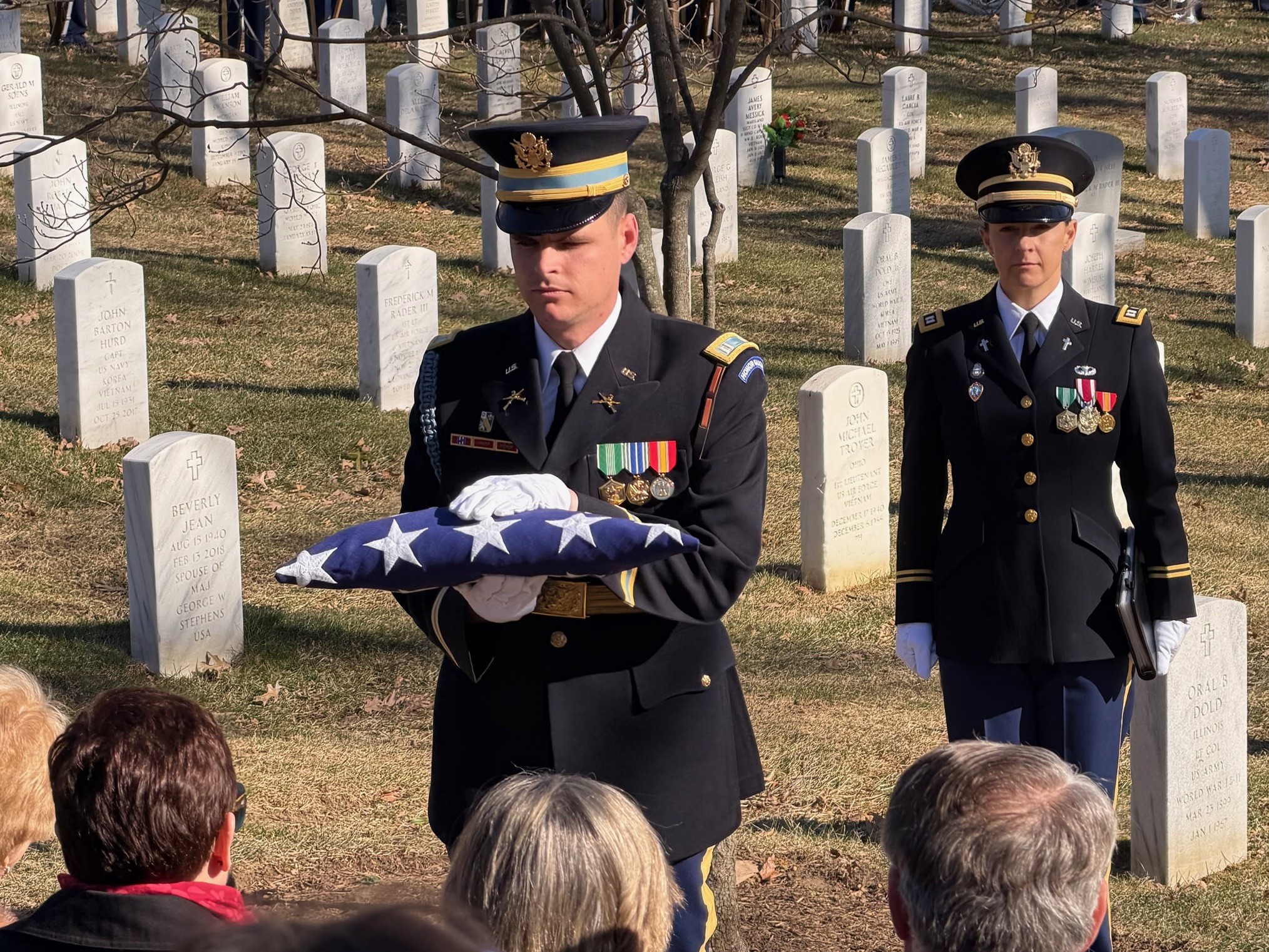
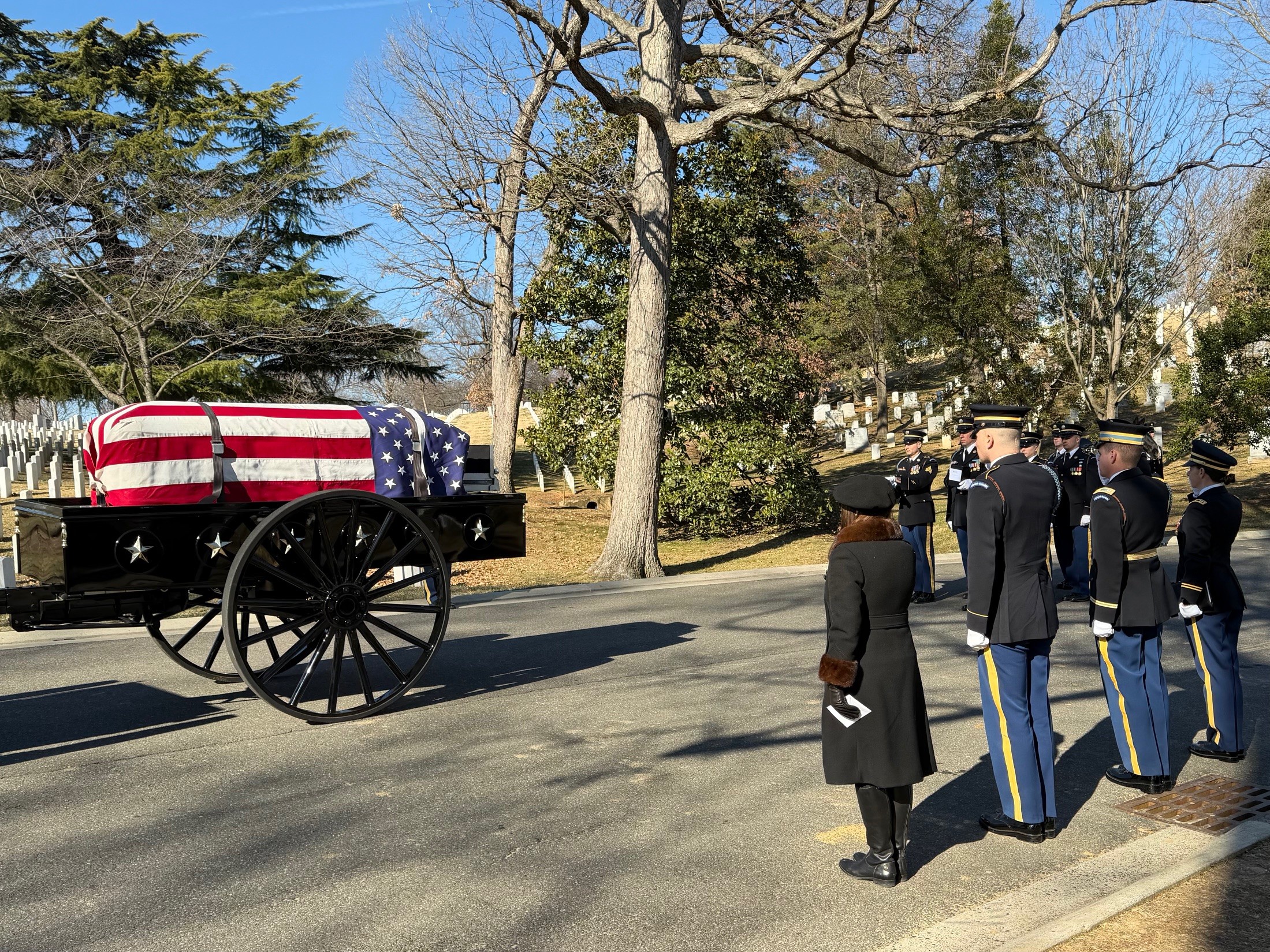
At the service, Islin’s flag-draped casket arrived by caisson. Army Chaplain (Capt.) Shannon Demoret listed Islin’s combat medals, including the Silver Star, the Legion of Merit, the Distinguished Flying Cross, the Bronze Star and the Air Medal. After a rifle team fired three volleys, a bugler sounded Taps. Fran cried as she accepted her husband’s folded flag. After the service concluded, funeral attendees lined up to say their final goodbyes. Roy Villaflor, who served as Islin’s crew chief during his second tour, placed a 227th Helicopter Assault Battalion emblem and a pair of aviation wings on the urn, a final salute to a leader and a pilot.
► Learn More: The Vietnam Helicopter Pilot and Crewmember Monument and Memorial Tree, in Section 35, honor the helicopter pilots and crew members who died while serving in Southeast Asia from 1961 to 1975.