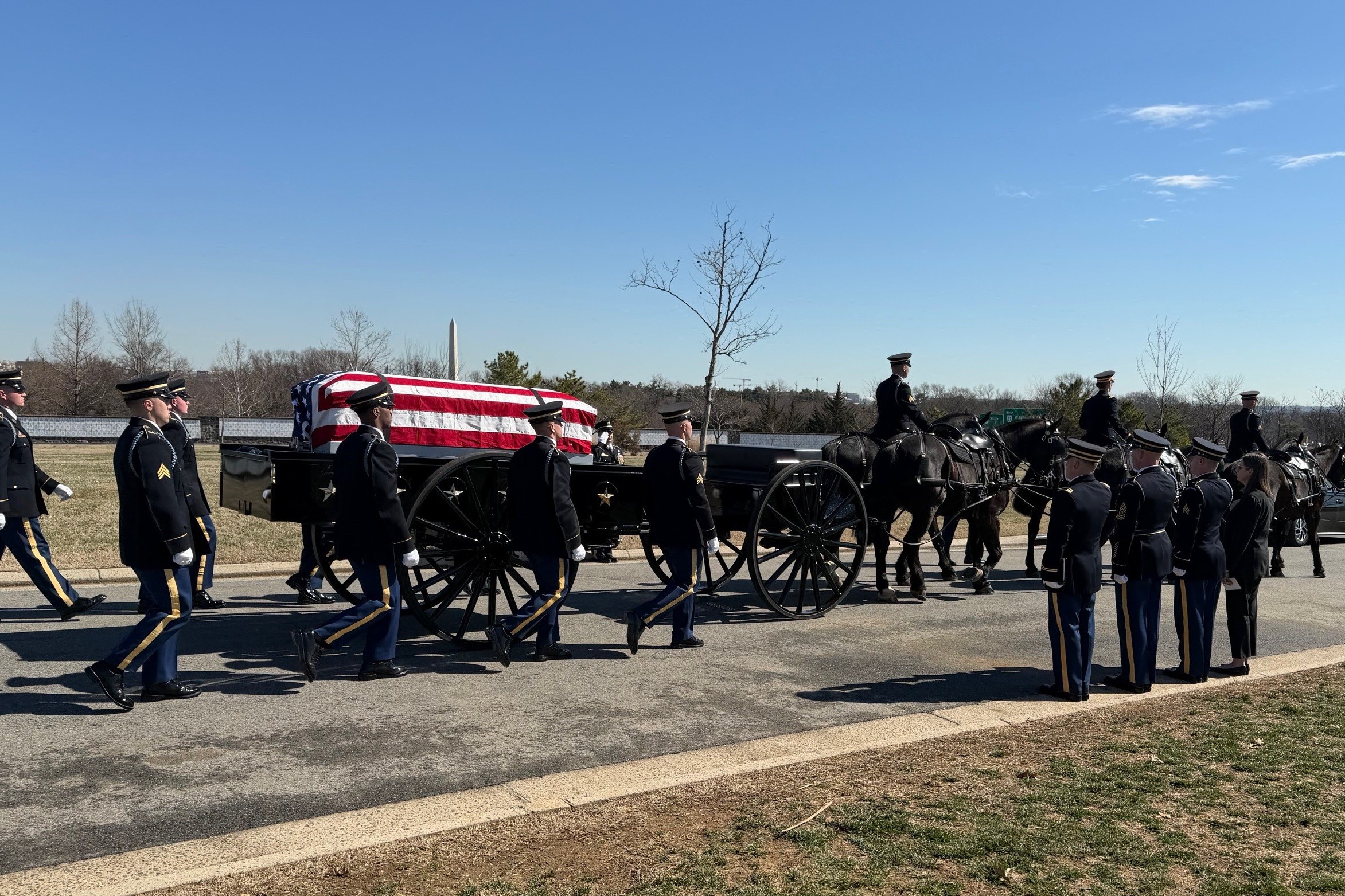
U.S. Army Pvt. Leonard “Buddy” Jackson, from Great Falls, Montana, survived fighting in the Philippines during the first year of American involvement in World War II, but died in a POW camp on Oct. 31, 1942, just one day shy of his 20th birthday. His fate would remain a mystery for more than 80 years until he was identified and later laid to rest at Arlington National Cemetery on March 9, 2026.
Days after Japan attacked Pearl Harbor on Dec. 7, 1941, Japanese troops invaded northern Luzon, in the Philippine Islands, and drove a combined American and Filipino force south to the Bataan Peninsula. After four months of brutal fighting, and with his men suffering from malnutrition and disease, the American commander on Bataan, Lt. Gen. Edward King, surrendered on April 9, 1942.
Jackson served south of Bataan on the island of Corregidor in Manila Bay. His unit, the 60th Coast Artillery, protected the island from enemy aircraft. On Dec. 29, the unit shot down 13 enemy bombers, although Jackson was injured during the attack. After the fall of Bataan, American forces on Corregidor held out for another month. The Japanese bombarded the island with artillery and aerial attacks until, on May 6, 1942, Lt. Gen. Jonathan Wainwright (buried in Section 1) surrendered the remaining U.S. forces in the Philippines. It was the largest surrender of American military personnel since the Civil War.
Although the surrendered troops on Corregidor were spared the horrors of the Bataan Death March, Jackson and his fellow soldiers spent weeks on the island as prisoners of war. Forced to sit outside, they were exposed to the elements with little food and water. Eventually, the POWs were shipped to Manila, where the Japanese military paraded them through the city’s streets, hoping the Filipino residents would jeer them—but they showed only sympathy and respect to the Americans. From there, the POWs were moved to the Cabanatuan POW camp, where they faced more deprivation.
Malaria, dysentery and hunger were common at the camp. In April 1943, the Japanese government announced that Jackson had died of amoebic dysentery on Oct. 31, 1942, more than five months after the surrender. He was buried in a common grave with six other POWs. Unaware of Jackson’s whereabouts or fate, his parents continually wrote the Red Cross but received no response.
During the process of exhuming American remains from Japanese POW camps after the war, the Army asked Jackson’s mother for his dental records, but she had none. The Army had identified six POWs from the common grave but, unable to identify Jackson, they declared him unrecoverable; his unknown remains were buried at the Manila American Cemetery and Memorial. His mother wrote to the Army to request her son’s personal items: “Please, if there is anything that does belong to him,” she wrote, “I would like to have it very much as he was the only boy I have got.” Yet nothing came.
Jackson’s mother and only sister (who kept a framed picture of him) passed away before learning of his fate. According to Jackson’s grandnephew, Shawn Miller, “We didn’t talk much about him, but there was a sort of pain that was in the house that everybody knew about.”
In 2016, the Army began DNA testing on unknown remains in the Manila American Cemetery and requested DNA samples from Jackson’s nephew, Ronald Mohr, and his grandnephew, Miller. Both proved perfect matches. On Dec. 16, 2024, an Army officer told Miller and his cousin, Tara Mylott, that Jackson had officially been identified. Miller teared up.
Jackson’s descendants chose Arlington National Cemetery for his final resting place. “It’s an appropriate thing to do for someone who’s been missing all these years,” Miller said. “It’s like he now belongs to the public.” Mylott agreed, adding, “This is a perfect place for him to be buried with other brothers in arms.”
At the funeral service in Section 57, U.S. Army Chaplain (Capt.) Philip Morlock stated that Jackson had served his nation honorably, especially having endured captivity as a prisoner of war. “Let it be known that he is a recipient of the Purple Heart, signifying that he has shed his blood in defense of our nation,” Morlock concluded.
Miller was touched by the full military funeral honors with escort service, which included a horse-drawn caisson, Army band, firing team and bugler. “The Army stuck to it and found him after 80 years,” he later said. He regretted that his grandmother and mother never learned of Jackson’s fate but appreciated that his story could be concluded. “I’m glad that there are still people around who have some memory of who he was,” he said.
Mylott, who accepted the flag that covered her granduncle’s casket, later reflected on his odyssey from the Philippines to the cemetery. “My mom worked really hard with the military trying to find him,” she said. “I’m carrying that on.”
► Explore our education materials and self-guided walking tours to learn more about World War II veterans laid to rest or honored at Arlington: