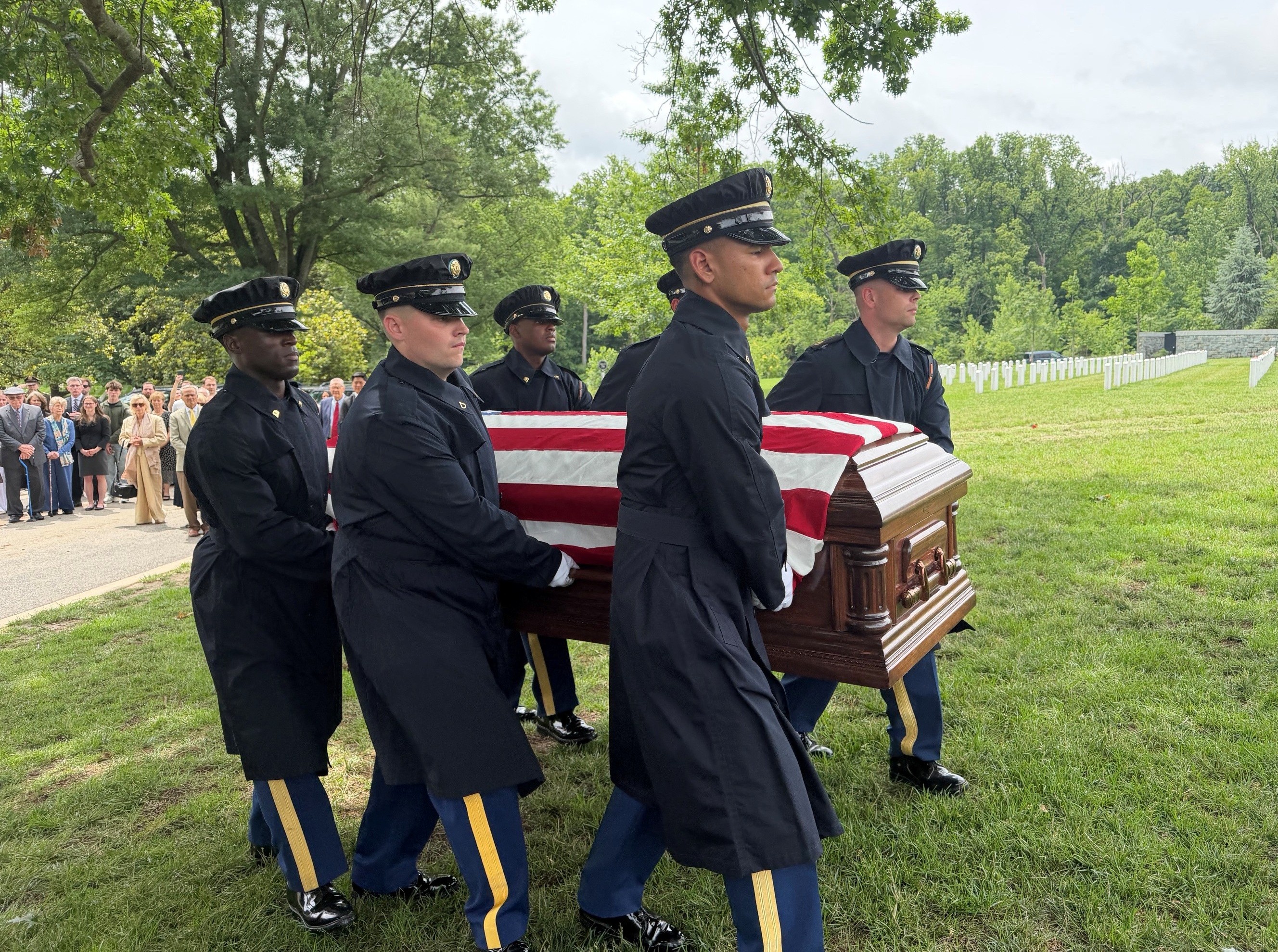
In 1945, nine-year-old June Laird saw U.S. Army soldiers ascending the 22 steps to her family’s home in Woonsocket, Rhode Island. They had come to deliver the news that her older brother, U.S. Army Air Forces Lt. Robert J. Barrat, had been reported killed in action over Germany. Lt. Barrat, the third eldest of six children, was only 20 years old when he died. What June did not know, at the time, was that her brother — laid to rest at Arlington National Cemetery (ANC) on May 27, 2026 — had died as a hero, whose brave actions during World War II inspired a German town to dedicate a monument to him and his bomber crew.
On Feb. 9, 1945, Barrat and his copilot were flying a B-17 bomber with the 303rd Bombardment Group. Amid heavy clouds over Lutzkendorf, Germany (today known as Krumpa), another bomber’s right wing hit the aircraft’s fuselage, shearing off the tail section.
Barrat’s damaged bomber dropped out of the sky and headed toward the town of Eisenburg. Just before it would have crashed in the town, possibly killing hundreds of people, Barrat and his copilot managed to level the aircraft and drop its bombs in a nearby field. Although their actions saved the town, eight members of the nine-man crew died in the crash. Only the tail gunner, who had parachuted out of the separated tail section, survived.
The news of Barrat’s death overwhelmed his mother, especially since her husband had died from a heart attack just six months earlier. Yet, as June recalled, she had begun to suspect that he had been killed in action when his letters suddenly stopped arriving. “She thought that was very suspicious,” June said.
Meanwhile in Germany, Eisenburg residents buried the deceased crewmembers at a local cemetery. In 1947, an American Graves Registration Command team recovered the eight sets of remains and sent them to Belgium, where two sets were identified. The other six, including Barrat, were buried together as unknowns at Jefferson Barracks National Cemetery in St. Louis, Missouri.
The Barrat family, then residing in Rhode Island and Massachusetts, made the long drive to St. Louis twice, in 1952 and 1957, to visit Robert’s burial place. Yet their mother rarely spoke of him. David Barrat, June’s younger brother, recalled asking questions about him, but all she would say is that he died in a plane crash.
In 1991, almost 47 years later, an Eisenberg resident located the crash site and recovered aircraft parts, additional human remains and — among the debris — a ring bearing the initials “R.J.B,” which turned out to be Barrat’s college ring. The human remains were brought to the Defense MIA/POW Accounting Agency’s (DPAA) Central Identification Laboratory in Hawaii, where scientists, using DNA samples provided by June and David, matched the remains from the site to Barrat. Four years later, Eisenberg residents erected a monument to the crew and informed June and David of their brother’s heroic actions to save civilians in their town.
June and David, Barrat’s surviving siblings, consequently decided that he deserved to be laid to rest at Arlington National Cemetery. “After I learned about the heroism and sacrifice of Robert and his crew in sparing the village of Eisenberg, I thought Arlington was the most appropriate place for him to be,” David said.
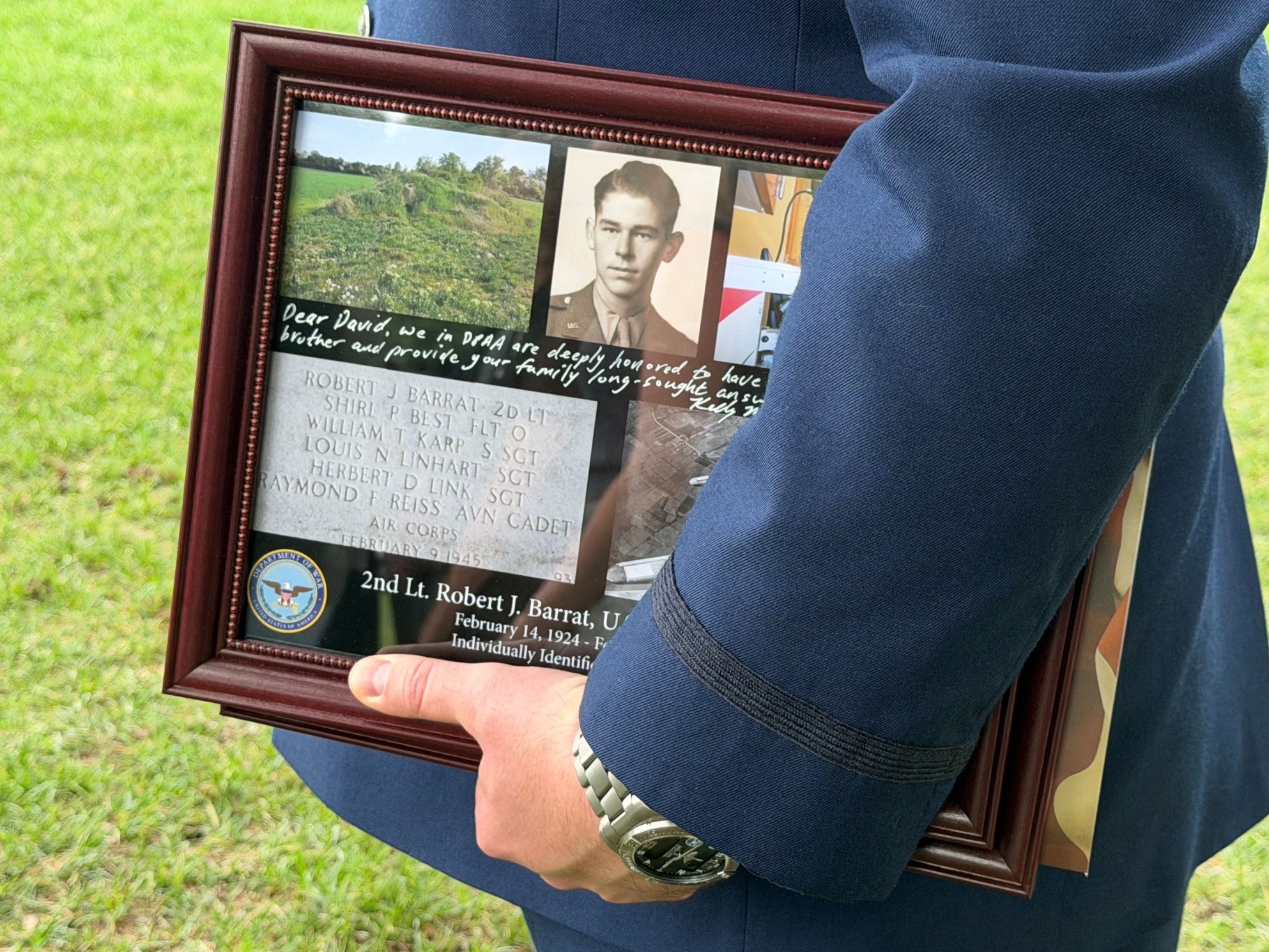
At the funeral service in Section 78, an Army lieutenant presented David with a tri-folded American flag. When the lieutenant saluted the flag, David put his hand on his heart. DPAA Chief of Staff U.S. Air Force Col. Derek Rankin later presented David with framed images of Barrat, a B-17 bomber, the crash site and his marker from Jefferson Barracks National Cemetery. David described the agency’s tireless efforts to find his brother as “an admirable thing.”
DPAA brought Barrat home; the people of Eisenburg, Germany, ensured that this American soldier would be remembered as a hero; and the funeral service enabled June and David to finally find closure, after their brother’s fate had remained a mystery for so long.