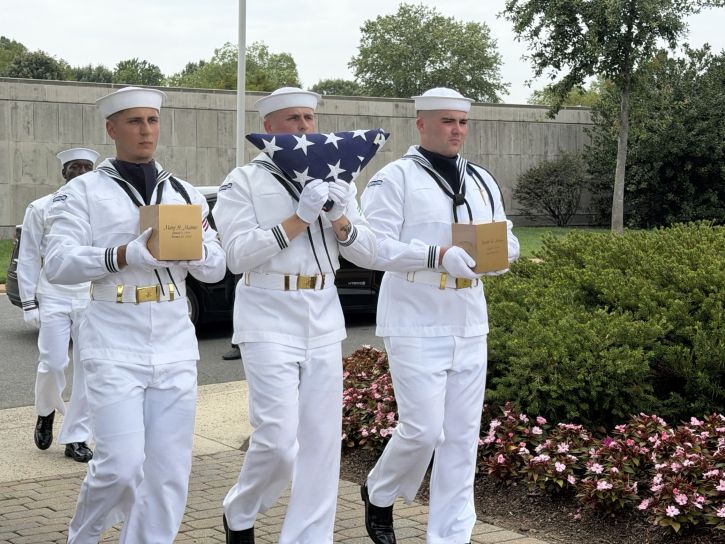
Joseph Manno rarely spoke about his combat service as a U.S. Navy hospital corpsman in the Pacific Theater during World War II, but he did document his Naval training experiences before he shipped out.
Manno, who was laid to rest with his wife, Mary, at Arlington National Cemetery on July 20, 2026, kept a unique diary while at Sampson U.S. Naval Training Station in Romulus, New York, in the summer of 1943. He bought a humorous cartoon book titled, “Sailors in Boots,” which contained single-panel sketches of Navy boot camp life with space below for personal writings. Manno took full advantage of the book, writing about the six-week culture shock of transforming from civilian to sailor.
The stark change of lifestyle, from simply waking up and eating mess hall food to training daily, shocked Manno. “I have never risen this early before, but I am slowly getting accustomed to it,” he wrote beneath a sketch of men getting out of their bunks. 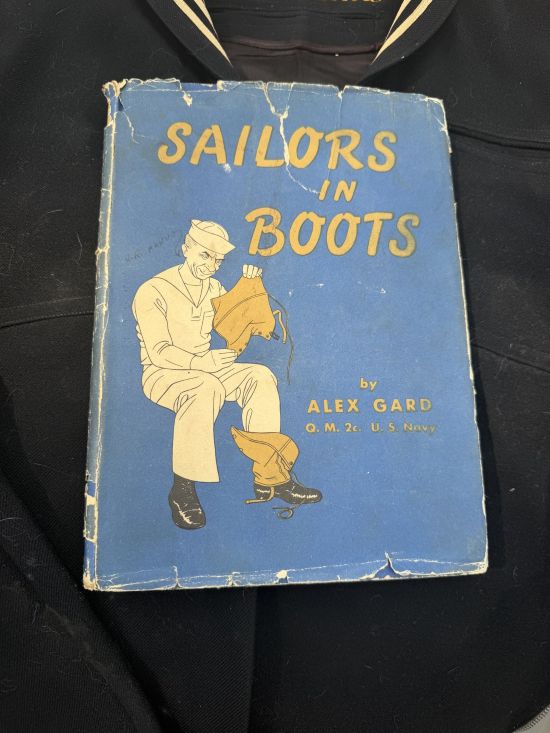
He found the cafeteria-style “chow” a new experience, with a Navy guard posted in the chow hall to make sure everyone ate their meals. “Food flew all over and you ate everything they gave you,” he wrote. “The Navy believes that ‘waste is criminal.’”
Training taught Manno not just how to be a sailor, but how to survive during combat. He learned to row a small boat with his fellow sailors on Seneca Lake. While he complained about the choppy water, it was nothing compared to the tear gas chamber, where sailors were exposed to gas to learn the importance of gas masks. “It made all of us come out crying,” he wrote.
On July 29, Manno completed his training. “And so ends ‘Boot Camp Leave,’” he wryly penned. “Destination[:] good guess is the South Pacific War.”
Manno never made it to the South Pacific, but he was close. He shipped out for the Central Pacific to take part in the invasion of Guam. By the time he reached shore, the fighting had moved inland.
Manno spent the rest of the war on Guam, serving as a hospital corpsman petty officer third class at Fleet Hospital III. He recalled Imperial Japan’s surrender on Aug. 14, 1945, known by the Allies as “V-J Day.” “Everyone was celebrating and waiting to go home,” he recalled.
After the war, Manno joined the Navy Reserve. He transferred back to the Navy when the Korean War broke out but was never deployed overseas. He instead pursued an education, eventually graduating from the University of Maryland with a doctorate in political science and working in both government and teaching professions.
Manno also married Helen Olesky after the war, and they had a daughter, Mercie, in 1955. Olesky passed away in 1961. More than a year later, Manno took Mary Hitselberger out on alunch date on Feb. 20, 1962. He remembered that precise date because astronaut John Glenn became the first American to orbit the Earth that day. They eventually married and had two children, Joan and Michael.
At the funeral service in Section 71, Father Michael Bryant called both Joseph and Mary heroes, stating that Manno’s Navy service reminded everyone that “We should never take freedom for granted.” He described Manno as a lifelong learner and Mary as selfless, kind and devoted to her family.
Manno’s eldest daughter, Mercie Malcomson, cried as Petty Officer 2nd Class Fikayo Adewunmi presented the flag that had accompanied her parents’ urns. After the service, Father Bryant led the family and friends to Columbarium Court Nine, where a cemetery team member gently placed both urns together in a niche.
Following the funeral, Michael Manno, who brought his father’s boot camp diary to the service, said that he was impressed by the Navy bugler’s sounding of Taps and the honor guard folding his father’s flag. “They did it with such reverence,” he said. He felt even stronger about choosing Arlington National Cemetery as his parents’ final resting place. “My father deserved it,” he said. “This place honors him for what he did.”