On a warm summer day in Arlington National Cemetery’s Section 81, U.S. Navy Chaplain (Lt. Cmdr.) Doyl McMurry stood among the rows of headstones and shared highlights of former Secretary of the Navy William “John” Middendorf II’s legacy with his family and friends. Although Middendorf died at age 101 and served only briefly in the Navy during World War II, McMurry reminded the mourners of his long legacy of service marked by honors and career accomplishments.
Middendorf’s career included a unique array of roles. After his brief military service, he went into investment banking and later served as the U.S. ambassador to the Netherlands (1969-1973), secretary of the Navy (1974-1977), ambassador to the Organization of American States (1981-1985) and ambassador to the European Communities (1985-1987). McMurry noted that Middendorf distinguished himself from his peers and dedicated himself to service. “He wasn’t as enamored with making a fortune as he was just making a difference,” McMurry said.
As secretary of the Navy, Middendorf supported the Ohio-class submarine, the Trident missile and the Ticonderoga-class guided missile cruiser. He named the F/A-18 fighter-bomber the “Hornet,” in honor of the Revolutionary War ship of the same name. He also helped found the Marine Corps Marathon. “There were a lot of marathons going on across the country at that time, and he liked to run,” Middendorf’s daughter, Amy Givler, explained. “He thought it was a good way of encouraging people to stay fit.” As a testament to his role in founding the race, the Middendorf Trophy is awarded by the Marine Corps Marathon to each year's winner.
Middendorf was equally as dedicated to his hobbies. Deeply interested in the arts, he collected art and sketched. He also wrote books, songs and symphonies. He worked on his music pieces late into the night, playing the piano while on the phone with a composer in Thailand. “Dad would stay up till three in the morning working on his songs,” recalled his oldest daughter, Frances Middendorf. “I don't know when he ever slept.”
Upon his 101st birthday, he made an addendum to his will: he wanted to be buried at Arlington National Cemetery. “He loved the Navy, and he loved Washington, D.C.,” Givler said. “He was also proud of his time as an ensign in World War II, that’s why he wanted Arlington.”
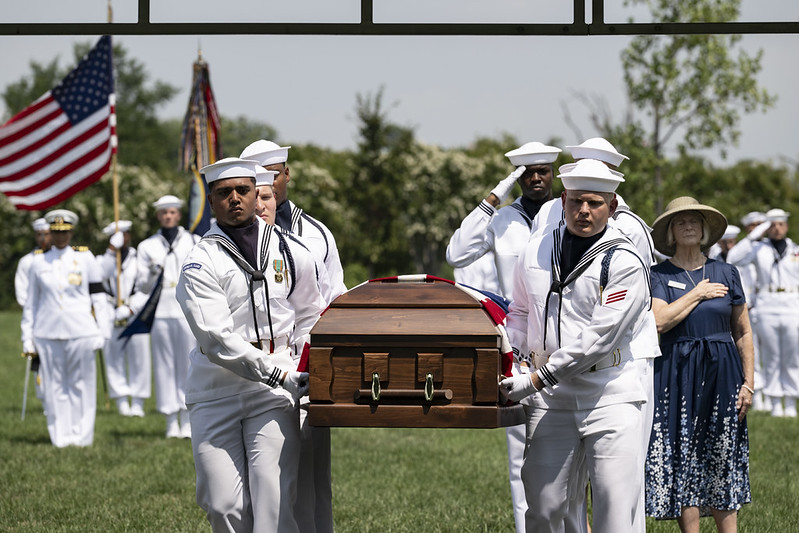
On Aug. 20, 2026, Middendorf’s loved ones gathered at the cemetery to say their final goodbyes. The full military funeral honors with escort service commenced with two P-8 Poseidon aircraft soaring overhead. He was honored with a caisson, Navy band, 19-gun salute, rifle party firing three volleys, a bugler sounding Taps and a sailor showcasing a blue Secretary of the Navy flag, with its distinctive anchor and four stars.
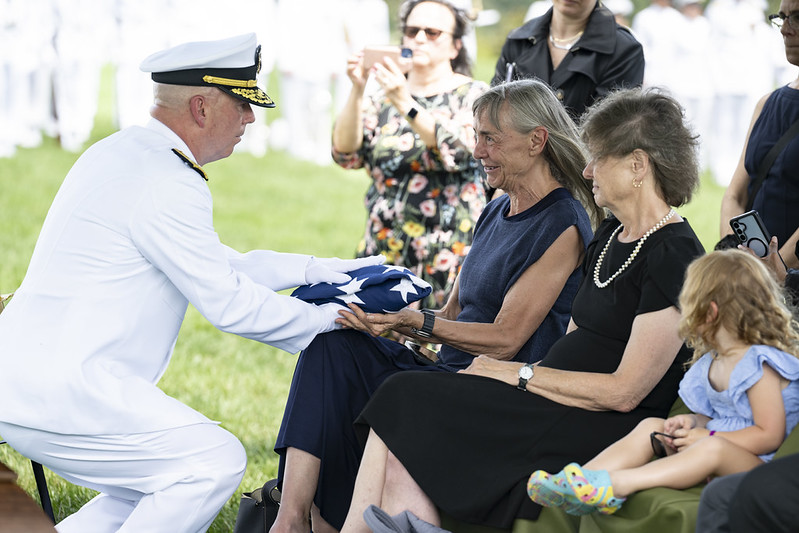
As Adm. William Houston, the director of the Naval Nuclear Propulsion Program, presented Frances with the flag that had been draped over her father’s casket, she reflected on her father’s belief in a resolute nation. “Dad lived for the idea that the United States would stay strong,” Frances said. “And that's what this flag means to me: that strength, that protection.”
Following the service, several of Middendorf’s friends and family remembered him as a Renaissance man. Ronald Ghenon, who worked for Middendorf in his later years, said he supported charitable causes, assisted people with disabilities and once replaced a stolen cello for a musician. “He was just a wonderful person,” he said. Philip Dunmire, past president of the Navy League when Middendorf chaired the awards committee, described him as an accomplished yet humble leader who remained engaged to the end. “At 101 he asked me to pass an idea along to the Navy’s leaders,” Dunmire said. “He was a great, almost iconic individual.”
Retired Navy Capt. Charles “Todd” Creekman, former executive director of the Naval Historical Foundation, recalled their work together, noting Middendorf’s passion for naval history and heritage: “It was important for him to make sure that the Navy’s history was well taken care of.”
Givler said she would remember her father as a curious intellectual. “He loved to meet people, but he wanted to know what they knew,” she said. “If he considered you to know what you were talking about, then that was a treasure trove for him.”
Before departing the cemetery, several mourners placed a hand on Middendorf’s casket as a final salute to a Renaissance man who spent a lifetime serving his country in and out of uniform.