American Revolution (1775-1783)
Arlington National Cemetery (ANC) is the final resting place for 11 veterans of the American Revolution. Many of these individuals were initially laid to rest in family cemeteries, churchyards, or small burial grounds that later deteriorated or were displaced by urban development. Years later, their remains were moved to Arlington through the efforts of family members, patriotic groups and the federal government.
During the American Revolution, the United States did not systematically care for its war dead or create national military cemeteries. After a battle, the victorious army, which controlled the battlefield, would usually bury the dead from both armies. Often, only officers would receive special care or ceremonies after their deaths. It was not until the Civil War that the United States began to take responsibility for its military dead in terms of identification, burial and the creation of national cemeteries. As a result, the remains of many soldiers from the American Revolution were scattered, lost, unidentified or buried without any commemorative marker. Many decades later, Arlington National Cemetery came to be seen as a suitable location for the reinterment of some veterans of the Revolution. The graves of Revolutionary War veterans later brought here confirmed Arlington's status as a national shrine representing all of the United States' major wars.
In addition to the six individuals featured below, five other Revolutionary War veterans are buried at Arlington National Cemetery: William Ward Burrows (Section 1, Grave 301-B), James House (Section 1, Grave 297-A), Thomas Meason (Section 1, Grave 297-B), Caleb Swan (Section 1, Grave 301-C) and Hugh Auld (Section 2, Grave 4801).
Together, the stories of these veterans demonstrate the nation’s longstanding commitment to honoring its earliest service members and remembering those who helped secure American independence.
Joseph Carleton (1754–1812) — During the American Revolution, Joseph Carleton served the Continental Army, but not in combat. Rather, he carried out essential administrative work that kept the Army organized, supplied, and functioning. Born in England, Carleton immigrated to America sometime before the start of the Revolution. In 1778, he was appointed to the Board of War and Ordnance, created by the Continental Congress to provide civilian oversight and administration of the Army. Three years later, he was elected Secretary to the Board of War, a precursor to the War Department. After the war formally ended in 1783, Carleton managed the War Department through this critical transition period. He handled the difficult task of disbanding the Continental Army and paying off wartime debts while also organizing a peacetime military system for a brand-new nation. He held this position until 1785. Carleton’s remains were moved to Arlington National Cemetery in 1907, after the Georgetown cemetery in which he was originally buried fell into disrepair. His reinterment highlighted the important but often overlooked type of wartime service performed by military members who served in non-combat roles. (Section 1, 299-WS)
John Follin (1761–1841) — The only Continental Navy sailor buried at Arlington, Follin demonstrated a lifelong dedication to the ideals of the nation he helped to establish. Shortly after he enlisted (at around 17 years old), a British warship destroyed his ship, and British sailors captured the young seaman as a prisoner of war. Follin was held captive for three years, facing harsh treatment that included whippings and minimal food. He was freed in a prisoner exchange toward the end of the Revolution. After the war, Follin remained a devoted patriot who instilled the importance of defending American liberties and independence in his children. Five of his sons defended these freedoms in the War of 1812, and one of his sons died as a result. When Follin died at age 80, he was initially buried in the graveyard on his family’s property in Fairfax County, Virginia. At the request of his family, Follin’s remains were reinterred at Arlington in 1911. (Section 1, 295-1-2)
John Green (1730–1793) — John Green led Virginia regiments in the Continental Army for nearly the entirety of the Revolutionary War. After the Continental Congress, in July 1775, directed the colonies to prepare for war by organizing military units, Green led efforts to recruit men from Culpeper County and surrounding areas in Virginia. He helped organize the Culpeper Minute Men, who fiercely defended Virginia during the early days of the war. The seals of both the county and town of Culpeper, Virginia, feature an illustration of them. Green was shot through the shoulder during the Battle of Mamaroneck (New York) in October 1776. Despite his injury, he continued serving until the end of the Revolutionary War, eventually reaching the rank of colonel. Green and his wife Susannah, originally buried in their family's cemetery, were reinterred at Arlington in 1911 thanks to the efforts of Green’s descendants, who also provided the large private marker that stands atop the grave. (Section 1, Grave 503)
Pierre Charles L'Enfant (1754–1825) — Perhaps the best-known Revolutionary War veteran buried at ANC, Pierre Charles L'Enfant was an engineer, architect and city planner who served in the Continental Army during the American Revolution and later designed the spatial plan for Washington, D.C. Born in France, L'Enfant came to America to fight for the revolution, and the Continental Congress commissioned him as a lieutenant in the Corps of Engineers. He served on George Washington's staff at Valley Forge, suffered a serious injury at the Siege of Savannah, Georgia (1779), and spent six months as a prisoner of war after being captured by the British during the battle for Charleston (1780). Discharged in 1784, when the Continental Army disbanded, L'Enfant established his reputation as an architect, receiving major commissions in Philadelphia and New York. He also designed the insignia of the Society of the Cincinnati, an organization of Continental Army officers. In 1789, he wrote President George Washington with a proposal to design the "federal city" that would be the new nation's capital; less than a year later, Washington appointed him to design what would become Washington, D.C. The L'Enfant Plan (whose original copy resides at the Library of Congress) envisioned Washington, D.C. as a four-quadrant grid, with north-south and east-west streets crossed by grand diagonal avenues. In conceptualizing the city plan, L'Enfant drew upon traditional European urban planning elements, along with neoclassical designs to emphasize the democratic character of the United States. Yet in spite of his war record and subsequent renown as a city planner, L'Enfant died in poverty on a Maryland farm, where he was originally buried in an unremarkable grave. In 1908, Congress appropriated funds for L’Enfant’s remains to be reinterred in “a place accessible to the public and to erect thereon a suitable memorial.” On the morning of April 28, 1909, L’Enfant’s casket arrived in Washington, D.C. and lay in state at the U.S. Capitol—making him the first foreign national accorded this honor. Later that day, the casket was transported with military escort to Arlington National Cemetery, where L'Enfant received a full military honors funeral. His remains were reinterred on a hillside overlooking the city he helped design. The marble monument, erected in 1911, features an engraving of L'Enfant's plan for the nation's capital. (Section 2, Grave S-3)
Lexington Minute Men Memorial Tree and Commemorative Plaque — When British soldiers marched to Lexington, Massachusetts, on the morning of April 19, 1775, they were faced by local militiamen sworn to be "ready in a minute" to resist British rule. A shot was fired — questions still remain about which side fired it — and the first battle of the American Revolution had begun. The Lexington Minute Men, a reenactment organization dedicated to preserving the history of the battle, donated a tree and memorial plaque to Arlington National Cemetery in 2000. This memorial tree honors the eight American “minutemen” who lost their lives on Lexington Green. The Lexington Minute Men memorial tree honors these men not simply as casualties of a single morning, but as participants in a turning point that shaped history. What began as a local act of resistance quickly became a national struggle over political authority, individual rights, and self-governance. Over time, the men who answered Lexington’s alarm came to represent more than a single moment of resistance to the British. They became symbols of the willingness of ordinary people to defend shared principles at great personal risk. (Section 1, directly opposite Follin's grave marker)
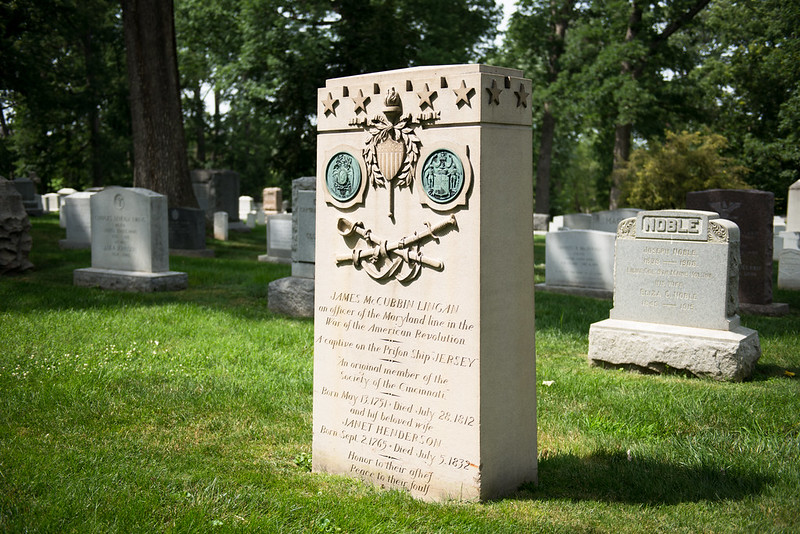
James McCubbin Lingan (1751–1812) — A Continental Army officer during the Revolutionary War, James McCubbin Lingan was an American patriot who believed deeply in the ideals of the Declaration of Independence and the freedoms guaranteed by the Constitution. He fought for those principles twice in his life — first as a young officer in the Revolutionary War and, later, at the cost of his life while defending freedom of speech and the press in 1812. While serving as a 2nd lieutenant in the Maryland and Virginia Rifle Regiment, he was severely wounded during the Battle of Fort Washington in November 1776 and captured by British forces. He endured three and a half years as a prisoner of war. After the war, George Washington, with whom Lingan was friends, appointed him as collector of customs at the port of Georgetown. He also served in Congress from 1800 to 1804. On July 28, 1812, Lingan was killed by a violent mob while defending a Baltimore newspaper’s right to publish editorials opposing the War of 1812. Lingan was originally buried at a cemetery in Georgetown (Washington, D.C.). During the early 20th century, as urban growth encroached upon his original burial ground, his granddaughters sought permission to have his remains reinterred at Arlington. With assistance from patriotic organizations, Lingan's relocation in 1908 ensured that both his Revolutionary War service and his later defense of civil liberties would be honored in this national setting. (Section 1, Grave 89-A)
William Russell (1735–1793) — Col. William Russell commanded several Virginia regiments during the Revolutionary War, leading troops at the battles of Brandywine, Germantown and Monmouth. During the Siege of Charleston, South Carolina, in May 1780, Russell, along with the rest of his garrison, surrendered to the British, who took them to the West Indies as prisoners of war. Later, after being freed due to a prisoner exchange, he rejoined the Continental Army and witnessed the British surrender at Yorktown in October 1781. After the war, neighbors celebrated his service by renaming Russell County, Virginia, in his honor. In 1783, the Continental Army brevetted Russell to brigadier general, and he served in the Virginia Senate from 1788 to 1789 and in 1791. Yet, when Russell died in 1793, he was buried quietly in a small private cemetery near Front Royal, Virginia. His grave bore no marker that identified him as a Revolutionary War officer. For more than 150 years, his resting place remained unmarked and largely forgotten. It wasn’t until one of Russell’s descendants began trying to find his gravesite in the 1930s that his service was remembered, recognized, and ultimately honored at Arlington National Cemetery. When the Army exhumed Russell’s remains in 1943, they found little beyond bone fragments, decayed coffin wood and handmade nails. Still, Arlington’s staff treated those remains with dignity and honor. Russell was reinterred on July 17, 1943. He was the last Revolutionary War veteran buried here and one of only two whose grave is marked with a standard government headstone. (Section 1, Grave 314-A)
Learn More
► Walking Tour: The Legacy of the American Revolution at ANC
► Education Program: Lesson plans and other learning materials on the Revolutionary War and America 250